By Dr. M. [Meyer Isser] Pines
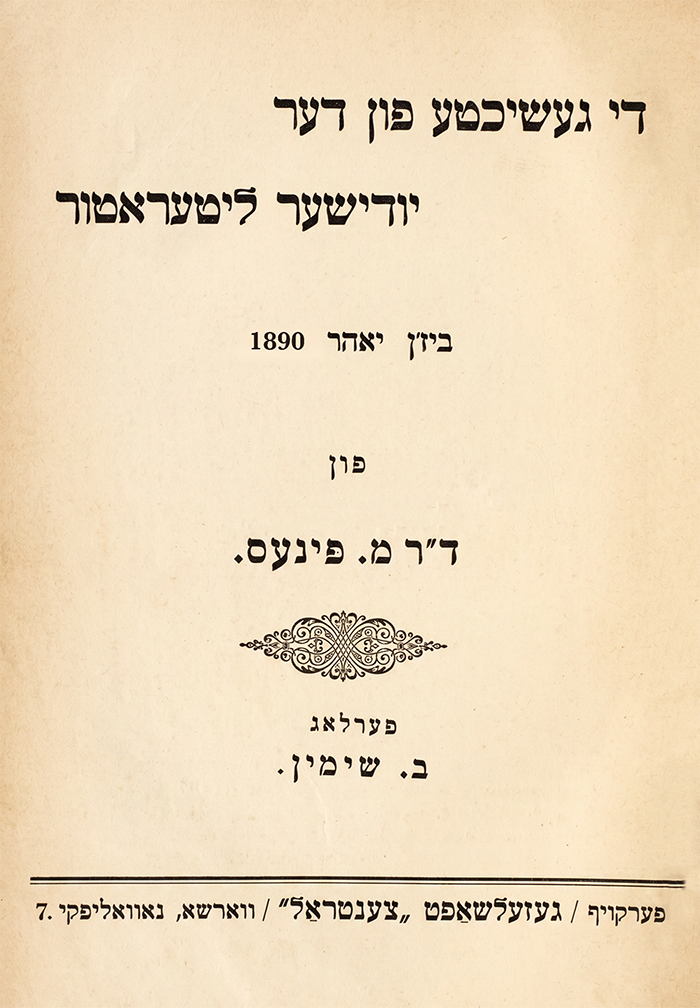
From Di geshikhte fun der yidisher literatur biz yor 1890
(The History of Yiddish Literature until the Year 1890)
Warsaw: B. Shimin Publishing House, 1911,
Vol. 2, Chapter 6, Pages 161–170
(See Yiddish Version Here)
Translated from the Yiddish by Mindy Liberman
Dinezon1, the best known among the folk-romance novelists in Yiddish literature, introduced the sentimental novel, or more accurately, the “tear jerker” to that literature. His first novel, Ha-ne’ehavim veha-ne’imim, oder, Der shvartser yungermantshik (The Beloved and Pleasing, or, The Dark Young Man)2 appeared in 1876. We can form a conception of Dinezon’s artistic credo from the remarks found in the short preface to that novel.
The Dark Young Man is an example of evil and treachery. In order to remain the sole owner of his stepfather’s property, he does not refrain from a vile denunciation of Yosef, a poor but handsome and learned yeshiva student, about to be married to the beautiful and virtuous Roza, the Dark Young Man’s stepsister. The denunciation is successful, and Yosef is thrown into prison. Roza, depressed and with a broken heart, unable to stand up any longer to her parents, who believe her beloved to be guilty, agrees to marry an imbecile found for her by the Dark Young Man. The day before the wedding, Yosef returns to the city because his innocence has been proven forever, although not until he has spent two years in prison. (The notion that he could interfere with the wedding or endeavor to have the young couple divorce does not even occur to him.) He wants to take his own life, but Roza’s sister, Rukhame, saves him from death. He has known her since she was a child, and she has grown to be a beautiful and accomplished young woman. She has loved him for a long time. Yosef is awakened to life and love once more. With Rukhame’s consent (she has promised to wait faithfully), he goes away to study. In five years or so, he returns, now a doctor, and is received warmly by Roza and Rukhame’s parents. They realize how vile their first good friend, “The Dark Young Man,” is. The latter, however, soon gets even with them. One night, he sets his stepfather’s house on fire. Yosef rescues Rukhame, but catches cold and dies. Rukhame also dies of a broken heart. “The Dark Young Man” has arranged everything so cleverly that no one even suspects him, and a thief is brought to trial in his place. He enjoys good fortune, wealth, and peace, and is respected by all.
The novel’s “sad” ending, where we see that evil—unlike in most novels—wins out by far, did not prevent the novel from being imaginative and interesting enough for the reader. It only meant that the ordinary reader who read the story with anguish right from the beginning and trembled over its beloved characters would shed a few more tears even after those shed while reading the story itself. He closed the book with an oppressed and wounded heart. It is interesting to note that in almost all of Dinezon’s novels, the same thing occurs: his sympathetic heroes always fall in battle; the bad ones are never “punished.” And so we see that the sad endings not only did not prevent the success of Dinezon’s novels, but on the contrary, may have helped him. This is very characteristic of the Yiddish-German reader, who for hundreds of years, evolved with a literature of tears and laments.
In his second novel, Even negef (Stumbling Block), first published in 18903, Dinezon also told a love story that ended unhappily. A young woman, Rukhele, loves her cousin Moshele. His Hasidic family, however, does not permit him to marry her. With Rukhele’s consent, he moves to Breslau, where the rebbe and his Hasidim consider him a heretic. The young woman marries another against her will. She runs away from her father’s house and dies, defeated by the accusations and superstition of those around her, by that which Moshele calls the “even negef” (stumbling block) in Jewish life, and he swears to fight it with all of his might in memory of his dead beloved.
In Even negef, as in The Dark Young Man, Dinezon follows in [Isaac Meyer] Dik’s footsteps, and appears to all as a moralist and ethics teacher. In the first novel, he wishes to portray evil and dishonest people in dark colors and make them ugly in the eyes of the people by means of the main character, the Dark Young Man. In Even negef, he again sets out to defend the idea of cultural development and religious tolerance. Sometimes he goes so far as to transform his novel into a means of education for the masses. Thus, in Even negef, for example, we see how Moshele captivates his beloved with an explanation about clouds.
It is superfluous to add that the characters in Dinezon’s novels discuss and speak throughout. The author does not look for his heroes in the magical world of rulers and princes, like Shomer [Nokhem Meyer Shaykevitch]. The environment he describes is the same as the one in which he lived and knew well, the same as that of his readers. Unfortunately, he doesn’t always describe it realistically and objectively. Sometimes, because the work demands it, sometimes, in order to generate hatred or compassion in the reader, he idealizes or denigrates his characters, and they say things that real living people would never say in those situations.
We must also recognize that one of the reasons that the characters in Dinezon’s novels, especially the main characters, make incorrect and unrealistic impressions, is due to a more general category, independent of the writer’s talent. Dinezon wanted to present a fundamental introduction to romance and, therefore, strived to produce romantic novels and love stories. This he was unable to do, as he never had the opportunity to observe it in the world that he portrayed.
Love might develop between the poor yeshiva boys and the beautiful and virtuous daughters of those families where they ate their meals, but social and moral controls did not allow this feeling to show itself in words or deeds. Above all, it was transformed into repressed suffering that would influence the entire life of the person in whose heart it grew. A daughter of Orthodox parents—like most of Dinezon’s heroines—considered speaking about love with a stranger to be a most serious moral sin. Should she forget herself and arrange a rendezvous with her beloved, no matter how innocent, it is only because she is being influenced by someone with views about moral issues that are different from those of the shy and observant yeshiva boys who are the heroes of Dinezon’s novels.
On the other hand, in addition to those in love, all of Dinezon’s sympathetic characters speak with such sugar-sweet language and shed so many tears that their true personalities become lost in the abyss of their superfluous speech and fabricated tears.
Only in the descriptions of Dinezon’s secondary characters, who don’t have the goal of educating or swaying our emotions, are the modest but effective talents of the author displayed. That was the case for the old servant Feige, a second mother to Rukhele, in Even negef, for example, or the poor teacher Shimele, who is truly dismayed that the rabbis required the same blessing for milk as for water, as he drinks the first glass of his goat’s milk. He is so delighted that he has a goat of his own that he wants milk to be as highly esteemed as wine, so that the same blessing would apply to both.4
In Der shvartser yungermantshik, Dinezon gave us the lifelike character of Sterne, “The Aunt of all the World,” a smooth talker, and a jealous woman who spreads malicious gossip. Shmaye the Kabbalist, who wants to bring the Messiah through fasting and miracles, is also a realistic and interesting figure. The caretaker of the synagogue agrees to flog him mercilessly for a few kopecks and carries out the job faithfully. When the pain becomes very sharp, Shmaya grits his teeth and complains: “This is nothing compared to the torments of hell.”5 In addition to these secondary characters, we find in the novels various depictions of community and Hasidic life described in fine, clear strokes, showing that Dinezon is an accurate observer.
Compared to his first novels, we find significant progress in Dinezon’s third novel, Hershele.6 It does not consist of four parts like Der shvartser yungermantshik or Even negef. No, it consists of only one part. What it loses in quantity it gains in quality. Here, too, we find a love story between a poor yeshiva student and the daughter of a family where he takes some of his meals, but the love story in this case is more realistic.
Here, love is not presented as a tragic force that causes the death of his beloved, but in the form of a gentle idyll between two gentle, innocent hearts. Hershele has a beautiful voice. Whenever he prays at the pulpit in synagogue, the worshippers cannot praise him enough. When, with the permission of the head of the yeshiva, he performs the role of Joseph in the biblical play, The Sale of Joseph, he captivates the young women in the city. Mirele, the daughter of the rich, miserly widow Brayndele, who provides meals for him on Wednesdays, is secretly in love with Hershele. She writes a false letter, as if from his aunt, in which the aunt supposedly says that she sends money to her nephew so that he can buy fine clothes. Thanks to her daughter’s efforts, Brayndele finds out about the letter and is thrilled that the young man whom she has befriended has wealthy relatives. With this in mind, Brayndele agrees with her only daughter’s suggestion to invite Hershele for the whole Passover holiday.
Hershele leads the seder with great success, and then, seated next to Mirele, begins to sing the Song of Songs. It seems to him that the words of love from the holy book that the sages say describe the relationship between God and the Community of Israel strongly reflect the feelings that he harbors for Mirele. On parting, the two clasp each other’s hands.
Sadly, the idyll does not last long. They live in a small town with evil tongues, and that ruins them. Borekh, a wealthy butcher, desperately wants Hershele as a son-in-law. He himself is a coarse ignoramus. His sons barely know the alphabet, but he thinks he would be happy to hear the beautiful voice of Hershele the yeshiva student in his house. He is stunned when Hershele refuses the match proposed for him. Borekh soon understands that Brayndele probably has a hand in this. His suspicion increases when he realizes that Hershele has chosen to spend the holiday in her home. Brayndele grows even closer to Hershele, but has no intention of marrying her only daughter, with her generous dowry and other gifts, to a poor yeshiva student. But she is completely unaware of the true situation. She does not notice her daughter’s love and does not hear Borekh’s claims. Brayndele’s brother, however, the synagogue gabay (official), knows the whole story. He is determined to make a quick end to all the commotion that risks spoiling his niece’s reputation. He chooses a harsh, drastic tactic. At his bidding, the police investigate the yeshiva. Since Hershele does not have the requisite official pass, they arrest him and send him back to his hometown. The story ends with an account of the arrest. We don’t know how things turn out for Hershele and Mirele. The author lets the curtain fall over the next events in the lives of his characters, as he should. Wishing to keep to the truth, Dinezon has to show us that each of the two heroes had to go his or her own way.
There are hardly any expressions of abstract ideals in the novel, and the story gains much from this. Unfortunately, the main characters are not portrayed in a lifelike enough manner, and their conversations are held in that “sweet” tone that we’ve already mentioned. The artistic interest of the novel lies especially in the secondary characters such as Brayndele, Borekh the butcher, Reb Shlomo the matchmaker, and others. The scene in which the Mekhiras-Yoysef (Sale of Joseph) is performed is particularly interesting. All of the roles, including women, are played by yeshiva boys, and the men and women in the audience are divided by a small wall.
Dinezon’s best-known and best book is Yosele.7 In this story about Jewish life, the author finally found his true voice. He tosses out the love stories that don’t go with the temperament of a sentimental writer of unhappy tales. It takes as its subject the sad story of a poor, kindhearted, and intelligent child who suffers bitterly from bad luck. Yosele’s parents are paupers. His father has tuberculosis and cannot work, and his mother toils day and night, barely earning enough to feed her large family. Yosele attends cheder, where all the other children are wealthy. He quickly notices how the teacher treats him differently from his friends.
One fine day, he finds a purse with a few rubles lying in the street. He gives the treasure to his mother, who uses part of it to pay tuition to the teacher and the rest to buy groceries. From that day on, Yosele is treated with more kindness in cheder and suffers less often from hunger. As time passes, however, there is once more no tuition money for the teacher. Again, the teacher’s heavy hand falls as if by accident onto Yosele’s back. At home, there is again terrible poverty. With his child’s mind, Yosele begins to perceive the source of his suffering, and dreams of finding another treasure.
One day, Yosele picks up a few kopecks that have fallen out of the teacher’s pocket. He takes them to his mother, saying that he found them. His mother suspects the truth, scolds him, and accompanies Yosele back to cheder to return the money. Yosele feels his crime keenly, repents, and swears on the Torah not to do it again. Nonetheless, he is banished from cheder. His friends call him “thief.” The other teachers, aware that his mother is in no position to pay regular tuition, refuse to accept him as a student. Yosele’s mother dies soon after, worn down by hardships and suffering. The child is left completely alone. He wanders through the streets, sleeps in the synagogue, and lives on the crumbs he finds in the street or receives from kind souls.
Yoyne the Water Carrier, a longtime good friend of his family, apprentices him to a shoemaker. His life is unbearable there because of his reputation as a thief. Certainly, no one looks into whether there is any truth to the story. From so much suffering and endless torment, pain, and troubles, one night he falls in the street hungry and dies.
It is difficult to demonstrate the more or less artistic elements in this story. We have presented the general features here. The events in Yosele’s life follow one another a little too quickly from the moment they call him “thief” until his tragic death. They develop in too straight a line, all in the same spirit, veering neither left nor right. We also have to acknowledge, however, that even when the developments are not realistic, they are still possible. On the other hand, the author describes for us with delicacy the psychology of a child who suffers a bitter fate, and who is so defeated by the troubles that befall him that he begins to refer to himself with the name the street has given him: “Yosele the Thief.” Yosele’s mother, cheerful, courageous, and strong even in poverty, Yoyne the Water Carrier, a folk type with a raw and picturesque way of speaking and a warm heart, Sheyndele, a wealthy, selfish woman who says upon hearing of Yosele’s death: “It’s better to be buried young than to sit in prison as an adult.” These and other characters in the story are portrayed properly and clearly.
After Yosele, Dinezon published Alterl, another story about childhood. He also wrote a great number of novellas that were published in various Judeo-German newspapers and journals. At first, Dinezon’s language had a flaw: many Slavic words were included. A welcome change took place in his last works, and from Hershele on, his language became clear and much more standard.
We will discuss in detail the second period of Dinezon’s writing, beginning at the end of the [18]90s, in the third volume.
[Editor’s note: Although a third volume is mentioned here, no copy has been located in existing bibliographies or library catalogs. Pines’ history was originally a doctoral dissertation published in French as Histoire de la littérature judéo-allemande (Paris: Jouve et Cie, 1911) and translated into Yiddish the same year.]
1 He was born in 1859 in New Zhager and spent his youth in Mohilev on the Dnieper River. He currently resides in Warsaw.
2 A novel in four parts, four editions, Vilna, 1889.
3 Even negef, oder, A shteyn in veg (Stumbling Block, or, A Stone in the Road), in four parts, by Jacob Dinezon, Warsaw, 1890.
4 Even negef, cited above, pp. 242–243.
5 Der shvartser yungermantshik (The Dark Young Man), cited above. Volume II, p. 49.
6 Hershele: A roman fun kleynshtetldike lebn (Hershele: A Novel of Small Town Life), Warsaw, 1895.
7 Yosele: Dertseylung fun yidishn lebn (Yosele: A Story of Jewish Life), Warsaw, 1903.